
Views: 0 Author: Site Editor Publish Time: 2026-06-29 Origin: Site


Procurement managers and engineers frequently hit roadblocks when relying on automated quoting algorithms for complex machined parts. These systems work fine for basic brackets but fail to capture the nuanced realities of advanced manufacturing, leading to unexpected budget overruns. The core problem is balancing tight tolerances and high-performance materials with strict project budgets, all while avoiding hidden fees tied to setup, tooling, and post-processing. Accurate budgeting requires understanding the specific variables that drive machine time and manual labor on the shop floor. By breaking down machine complexity, cost multipliers, and actionable design strategies, you can optimize part design for maximum efficiency. This guide provides a transparent look into the factors determining the true cost of Custom CNC Machining, empowering you to make informed engineering and purchasing decisions.
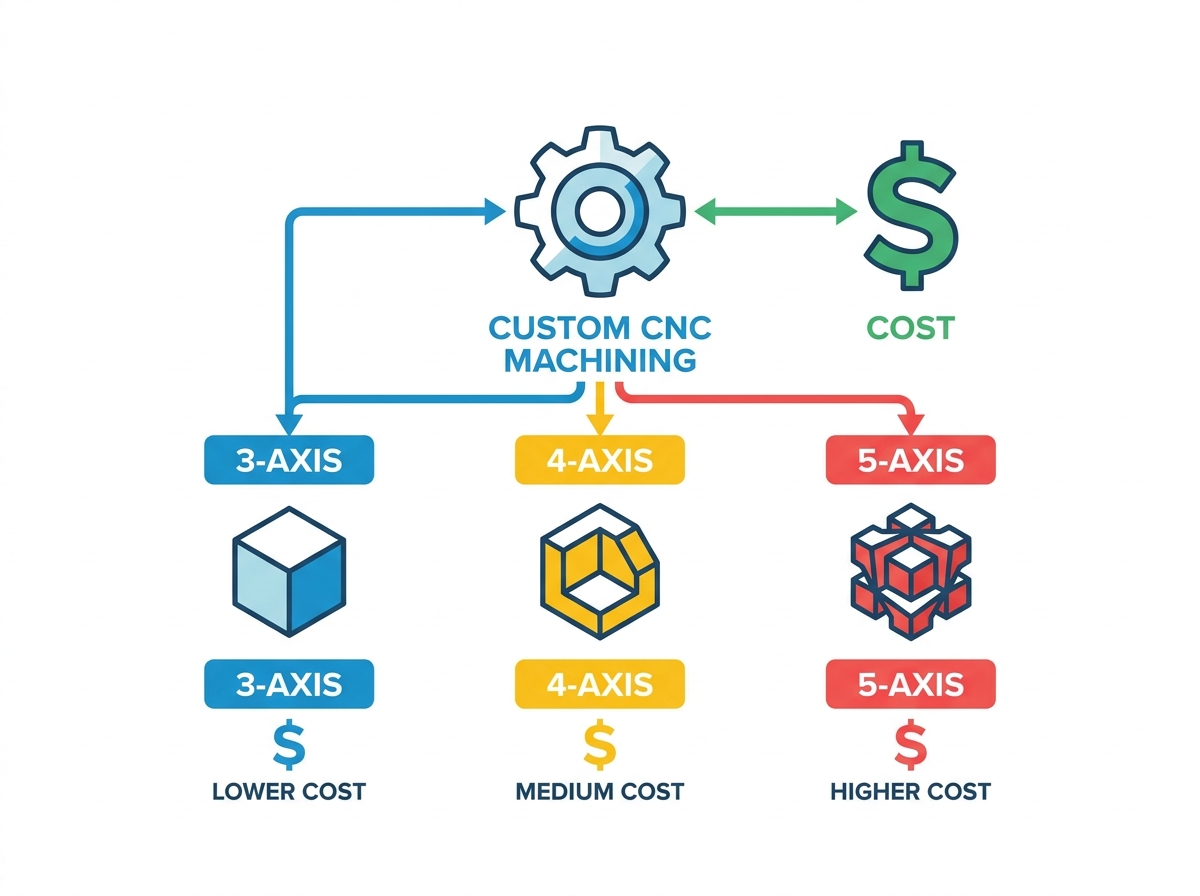
Hourly Rates Vary by Machine Complexity: Standard 3-axis milling typically ranges from $35 to $120 per hour, while advanced 5-axis machining can exceed $250 per hour.
Setup and Programming Dictate Low-Volume Costs: CAD/CAM programming and custom fixturing are fixed costs; amortizing these across larger batch sizes drastically reduces the per-part price.
Material Machinability is a Primary Cost Driver: Raw material price is only half the equation; harder materials increase tool wear and require slower feed rates, driving up machine time.
Tolerances Multiply Expense: Specifying tighter tolerances than functionally necessary is the most common reason for inflated custom CNC machining quotes.
The "Design-Ready" Discount: Providing clean, machine-ready 3D CAD files eliminates non-recurring engineering (NRE) fees, whereas supplying paper sketches or 2D drafts can add significant manual drafting costs ($60–$100+/hour).
Understanding how machine shops calculate their quotes is the first step in controlling your manufacturing budget. The standard formula generally follows a strict structure: Total Cost equals one-time setup and programming fees, plus the combined machine and labor hourly rate multiplied by the run time, plus material costs, post-processing, and standard overhead margins. Knowing this equation allows you to identify exactly where your resources are allocated during a production run.
Many precision shops enforce a Minimum Order Value (MOV). This threshold exists to offset the baseline administrative labor, CAM programming, and physical machine setup costs required for a single-part run. Ordering a single prototype often triggers this minimum, making the per-unit cost appear artificially high compared to production batches. When machinists load tools, indicate vises, and touch off work offsets, that labor takes the same amount of time whether they are cutting one part or one thousand parts.
When utilizing Three-axis CNC machining services, the cutting tool moves across the X, Y, and Z linear axes simultaneously. This method is ideal for simpler geometries, flat profiles, and parts requiring machining on a single face. The workpiece remains stationary in a standard machine vise while the spindle performs the milling operations from above.
This represents the lowest barrier to entry and remains highly cost-effective for standard brackets, mounting plates, and basic enclosures. Because the machine kinematics are straightforward, CAM programming takes less time, and the physical setup is usually limited to standard workholding. However, if a part requires features on multiple sides, the operator must manually unclamp, flip, and re-indicate the part. This manual intervention introduces additional labor and potential alignment errors, which can offset the initial savings if the part geometry is too complex for a single setup.
Stepping up to Four-axis CNC machining services introduces a rotary axis, typically designated as the A-axis. This allows the workpiece to rotate along the X-axis, enabling continuous machining on cylindrical parts or multiple sides without manual repositioning. Shops often utilize tombstones or rotary indexers to hold multiple parts at once, presenting different faces to the spindle automatically.
This capability reduces the labor costs associated with manual part flipping, effectively offsetting the higher hourly machine rate for moderately complex components. By keeping the part clamped in a single fixture while rotating it to access different faces, machinists maintain tighter geometric dimensioning and tolerancing (GD&T) relationships between features. True position and concentricity are much easier to hold when the part does not leave the fixture.
Advanced Five-axis CNC machining services utilize the standard three linear axes plus two additional rotary axes (usually B and C). These machines are capable of cutting highly complex, organic geometries and deep cavities in a single setup. The cutting tool can approach the workpiece from virtually any angle, allowing for shorter, more rigid end mills that reduce vibration and improve surface finish.
While the hourly rate is a premium investment, the elimination of multiple setups and the ability to achieve extreme precision often makes it the most economical choice for aerospace, medical, and complex automotive components. Five-axis simultaneous milling allows for swarf cutting and complex surfacing that would be physically impossible or prohibitively time-consuming on a standard three-axis mill. The reduction in manual handling also drastically lowers the scrap rate on high-value materials.
Beyond the raw hourly rate of the machine, specific engineering and procurement decisions act as significant cost multipliers. Evaluating these variables during the design phase is critical for keeping projects under budget. Every feature drawn in CAD translates directly to toolpath time on the shop floor.
Raw material costs vary wildly based on market conditions and alloy composition. Common plastics like Delrin and Nylon carry lower baseline costs compared to metals such as Aluminum 6061, Stainless Steel 304/316, or Titanium. However, raw material price is only one factor. When utilizing Metal CNC machining services, machinability ratings play a massive role in the final quote.
Machinability refers to how easily a metal can be cut without causing excessive tool wear or requiring slow spindle speeds. Aluminum 6061 machines quickly with low tool wear, allowing for aggressive feed rates and deep depths of cut. In contrast, Titanium alloys and Inconel require slow feed rates, highly rigid setups, and frequent cutting tool changes. These superalloys generate immense heat at the cutting edge, necessitating high-pressure through-spindle coolant and specialized carbide inserts, exponentially increasing total machine time.
Material Grade | Machinability Rating | Tool Wear Impact | Ideal Application |
|---|---|---|---|
Aluminum 6061-T6 | Excellent | Low | General structural components, enclosures |
Brass 360 | Excellent | Very Low | Fittings, low-friction gears, decorative parts |
Stainless Steel 304 | Moderate | Medium | Corrosion-resistant brackets, food-grade parts |
Titanium Ti-6Al-4V | Poor | High | Aerospace components, medical implants |
Inconel 718 | Very Poor | Extreme | High-temperature turbine blades, exhaust systems |
Sending hand-drawn sketches, basic PDFs, or non-vector files forces the machine shop to manually draft the part in CAD software. This penalty incurs a separate design labor fee with a minimum charge. Machinists cannot generate toolpaths from a 2D drawing; they require a solid model.
Converting a 3D CAD model into G-code toolpaths requires CAM software. This non-recurring engineering (NRE) charge increases directly with the complexity of the required toolpaths. A programmer must select the correct tools, calculate speeds and feeds, define step-overs, and simulate the cutting process to prevent machine crashes. Complex 3D surfacing requires significantly more programming time than simple 2D contouring and pocketing.
Part geometry directly dictates tooling requirements. Deep pockets, thin walls, and sharp internal radii require specialized tooling and significantly slower machining speeds to prevent chatter and tool deflection. When an end mill extends too far from the tool holder, it loses rigidity. Machinists must reduce their depth of cut and feed rate to compensate, adding hours to the cycle time.
Furthermore, Precision CNC machining services are heavily impacted by tolerance demands. Standard block tolerances are economical. Tight tolerances require thermal stabilization of the machine environment, specialized CMM inspection, and carry a higher scrap risk. Hitting a tight bore tolerance often requires boring heads or reamers rather than standard end mills, adding another tool change and cycle to the operation.
Prototyping runs of 1 to 10 parts carry a high per-part cost due to unamortized CAD/CAM programming and physical machine setup time. The machinist spends more time setting up the job than the machine spends actually cutting metal.
Moving into low-to-mid volume production hits a sweet spot. Here, fixed setup costs are distributed across the batch. Operators can optimize the CAM program after the first article inspection, increasing feed rates and reducing cycle times for the remainder of the run. This makes the process highly competitive against alternative methods like injection molding or casting for mid-volume quantities.
Secondary operations frequently catch buyers off guard during the quoting process. Identifying these blind spots early prevents budget shock upon final delivery. A part is rarely finished the moment it comes off the mill.
An "as-machined" finish is the most economical option, leaving visible tool marks on the surface. Custom finishes add distinct cost layers and extend lead times. Bead blasting provides a uniform matte finish but requires manual labor in a blast cabinet. Type II or Type III hardcoat anodizing, powder coating, electropolishing, and passivation all require external processing time at specialized plating facilities.
Masking requirements add intensive manual labor. If a part requires anodizing for corrosion resistance but needs bare metal contact points for electrical grounding, operators must manually apply masking plugs or tape to those specific features before the chemical bath. This hand-work scales linearly with production volume.
Standard workholding uses standard vises and step jaws. Complex parts with organic shapes or thin walls cannot be clamped in a standard vise without crushing or distorting the material. In these cases, the shop must machine custom soft jaws, vacuum fixtures, or dedicated mounting plates simply to hold the part securely during cutting.
This custom fixturing is a non-recurring fee passed directly to the buyer on the initial run. The shop must design the fixture in CAD, program it in CAM, and machine it out of raw aluminum or steel before they can even begin working on your actual parts.
Pushing a project to the front of the production queue disrupts the shop's existing machine schedule. This speed typically incurs a premium to cover overtime labor, expedited material shipping, and the opportunity cost of delaying other scheduled work. Spindle time is a finite resource, and rearranging the production board requires administrative effort and machine downtime.
Engineering and procurement teams can actively mitigate expenses by optimizing designs before ever requesting a quote. Following standard Design for Manufacturability (DFM) rules is the most effective cost-reduction strategy. A few minor CAD adjustments can drastically reduce cycle times.
Internal radii are critical. Specify added radii to internal vertical corners to allow the shop to use larger, faster end mills rather than tiny, fragile tools. A sharp internal corner requires an electrical discharge machining (EDM) process or broaching, which adds entirely new operations to the routing.
Restrict hole depths to four times their diameter and limit thread depth to twice the diameter to prevent tool breakage and reduce cycle time. Deep hole drilling requires specialized parabolic drills and peck-drilling cycles to clear chips, slowing down the machine. For metals, avoid designing walls thinner than 0.030 inches to prevent warping and vibration during aggressive cutting.
Apply tight tolerances exclusively to critical mating surfaces, bearing fits, or sealing grooves. Leave the rest of the part geometry subject to standard block tolerances. Over-tolerancing non-critical features forces the machinist to slow down and inspect dimensions that do not impact part functionality.
When a drawing specifies a tight tolerance across every dimension, the shop must assume the worst-case scenario and quote the job using the most conservative machining strategies. By isolating the critical features, you allow the programmer to rough out the bulk of the material quickly and only slow down for the final finishing passes on the mating surfaces.
Calculate the setup ratio to find your break-even point. Ordering slightly more parts drastically reduces the unit price because the heavy setup and programming costs are already absorbed. Stocking slightly more inventory is frequently more economical than paying for a second setup a few months later.
Consider the time it takes to tear down a previous job, clean the machine, load new tools, set tool length offsets, indicate the vise, and run a first article inspection. That block of time is fixed. Spreading that fixed block over 100 parts instead of 10 parts changes the financial dynamic of the entire project.
Comparing quotes requires looking beyond the bottom-line amount to assess the total value and risk mitigation offered by the machining partner. The lowest quote is not always the most economical choice if it results in rejected parts or missed deadlines.
Overseas shops often advertise lower hourly rates. Buyers must weigh these savings against the risks of intellectual property theft, communication barriers, shipping delays, customs duties, and inconsistent material certifications. Time zone differences can turn a simple engineering clarification into a multi-day delay.
Domestic partners often provide faster iteration cycles and more reliable accountability. When dealing with complex assemblies or tight-tolerance aerospace components, the ability to pick up the phone and speak directly with the CAM programmer or shop foreman is invaluable. Domestic shipping also eliminates the unpredictability of ocean freight and customs holds.
A quote from an ISO 9001, AS9100, or ITAR-registered facility serves as a necessary insurance policy for critical applications. These certifications guarantee that the shop adheres to strict quality management systems, material traceability protocols, and calibrated inspection procedures.
Evaluate whether the quote includes comprehensive First Article Inspection (FAI) reports and Material Test Reports (MTRs). Rigorous quality assurance prevents costly failures in the field. A shop that utilizes automated CMM probing and optical comparators will catch dimensional deviations before the parts ever leave their shipping dock.
Audit your current CAD files to ensure internal radii are maximized and unnecessary tight tolerances are removed from non-mating surfaces.
Calculate your optimal batch size to ensure setup and programming fees are efficiently amortized across the entire production run.
Evaluate vendor quotes based on total landed cost, factoring in shipping, required finishing, and quality assurance documentation.
Export clean, machine-ready 3D models in STEP or IGES formats alongside clear 2D PDF drawings to eliminate manual drafting fees.
A: CAM programming is billed as a non-recurring engineering fee. Depending on part complexity, shops charge an hourly rate to convert your 3D CAD model into the G-code toolpaths required by the machine. Simple 2D parts take less than an hour, while complex 5-axis surfacing can take several hours to program and simulate.
A: Five-axis machines represent a massive capital investment and require highly skilled programmers to operate. They can machine complex parts in a single setup, often making the total project more economical by eliminating manual repositioning labor and reducing the need for multiple custom fixtures.
A: Yes. Material cost is only part of the equation. Harder metals like titanium or Inconel have poor machinability ratings, meaning they require slower cutting speeds and cause rapid tool wear, which drastically increases machine time and tooling costs compared to cutting aluminum or brass.
A: Setup fees are unavoidable as physical tools must be loaded, work offsets established, and machines calibrated. To minimize their impact, increase your batch size to amortize the fixed setup cost over more units, lowering the per-part price significantly.
A: Yes. Pushing tolerances tighter than standard block limits requires slower machining, specialized cutting tools, strict temperature control, and extensive manual inspection. Machinists must take spring passes and measure frequently, all of which add significant time and labor costs to the final part.


