
Views: 0 Author: Site Editor Publish Time: 2026-06-01 Origin: Site


Partnering with the wrong supplier introduces compounding costs that derail production schedules. These risks range from premature tooling failure and unacceptable porosity rates to severe supply chain disruptions. When components fail to meet dimensional tolerances or structural requirements, the resulting rework and scrap rates quickly erode margins. The core business problem lies in balancing steep upfront tooling investments with the need for long-term part consistency, scalable production, and rigorous defect mitigation. Selecting a manufacturer based solely on piece-part quotes ignores machine capability, material expertise, and quality control infrastructure. A strategic approach ensures the chosen vendor delivers reliable results over the entire product lifecycle. This guide provides a systematic, evidence-based framework for evaluating partners based on technical capabilities, quality control infrastructure, and overall lifecycle value rather than just initial estimates.
Align capabilities with material needs: Prioritize manufacturers with verifiable, high-volume expertise in your specific required alloys (e.g., aluminum, zinc, magnesium) and the appropriate machine tonnage.
Demand rigorous defect mitigation: Assess quality assurance protocols specifically regarding porosity control, dimensional tolerance adherence, and in-house non-destructive testing (NDT).
Evaluate overall lifecycle value: Factor in tooling lifespan guarantees, secondary machining capabilities, and supply chain logistics to calculate true ROI.
Protect intellectual property and assets: Require transparent tooling ownership agreements, first article inspection (FAI) validation, and physical samples before committing to high-volume production.
Establishing clear production parameters is the mandatory first step in vendor evaluation. You must define minimum order quantities (MOQs), peak capacity requirements, and acceptable lead times for both tooling fabrication and production runs. A manufacturer might handle prototyping efficiently but struggle to scale up when demand spikes. Ensure their facility has the capacity to absorb your projected volume increases without compromising delivery schedules. Evaluate their Overall Equipment Effectiveness (OEE) and shift scheduling to verify they have the operational bandwidth to meet your deadlines.
Calculate your baseline monthly volume requirements.
Determine the maximum surge capacity needed during peak seasons.
Establish hard deadlines for first article inspection (FAI) delivery.
Define acceptable lead times for full production runs post-approval.
Matching mechanical properties to specific alloys dictates part performance in the field. Different applications require varying levels of yield strength, thermal conductivity, and weight reduction. Common alloys like A380, A356, and Zamak 3 each offer distinct advantages. Evaluate the manufacturer's alloy selection process, focusing on their understanding of corrosion resistance, strength-to-weight ratios, and post-casting compatibility. Their expertise ensures the chosen material aligns perfectly with the functional requirements of your component.
Alloy Type | Primary Characteristics | Common Applications | Machinability Rating |
|---|---|---|---|
Aluminum A380 | Excellent balance of castability and mechanical properties. | Engine brackets, electronic housings, gearboxes. | High |
Aluminum A356 | Superior elongation and high strength; heat-treatable. | Structural automotive components, aerospace parts. | Medium |
Zinc Zamak 3 | Exceptional dimensional stability and finishing characteristics. | Hardware, complex net-shape components. | Very High |
Magnesium AZ91D | Extremely lightweight with high strength-to-weight ratio. | Handheld devices, steering wheels, power tools. | High |
Before selecting a vendor, clearly define critical-to-quality (CTQ) dimensions, draft angle limitations, and wall thickness constraints. Complex geometries demand specific tooling designs and process controls. If your part features intricate details or requires tight tolerances, the manufacturer must demonstrate the capability to consistently achieve these specifications. Discussing these thresholds upfront prevents costly redesigns and ensures the vendor possesses the necessary technical proficiency. Standard draft angles typically range from 1 to 2 degrees, but deeper cavities may require more aggressive drafting to prevent part ejection issues.
Matching your part's projected surface area and cavity requirements to the manufacturer's available locking force is essential. Insufficient tonnage leads to flash formation and dimensional inaccuracies during the injection phase. Verify that the facility operates machines with adequate locking force to handle the specific size and complexity of your components, ensuring consistent quality across high-volume runs. The calculation involves multiplying the projected area of the part (including runners and overflows) by the specific injection pressure required for the alloy.
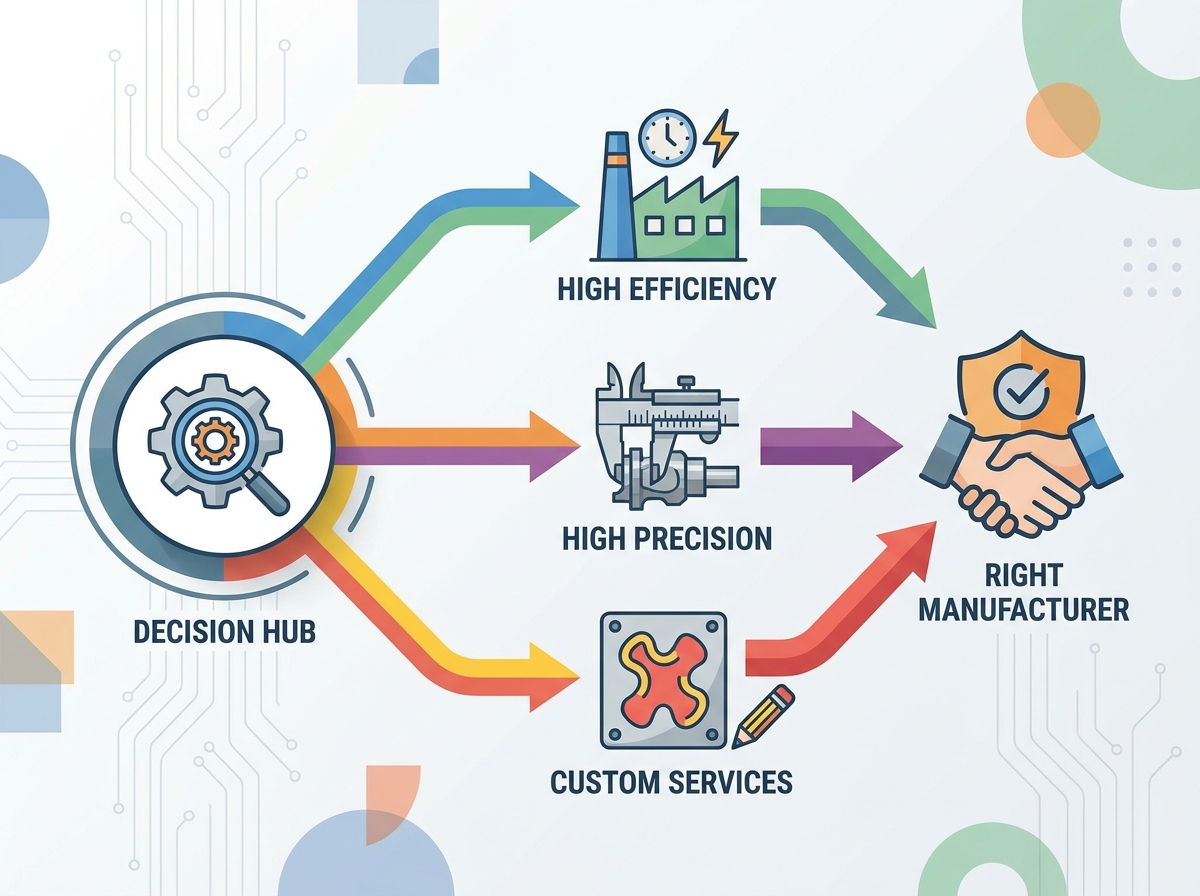
Evaluate the vendor's commitment to optimizing production through advanced technology. Look for the implementation of automation, robotics, and multi-cavity tooling. These elements, combined with optimized cycle times, are key indicators of High efficiency die casting services. A manufacturer utilizing automated ladling, robotic part extraction, and automated die spraying can significantly drive down unit costs at scale while maintaining consistent part quality. Automation removes human error from the cycle time, ensuring thermal consistency within the die.
When working with aluminum, specific process expertise is required. Validate the vendor's proficiency in cold chamber processes, which are necessary for high-melting-point alloys. A reliable High precision aluminum die casting service will utilize advanced thermal monitoring of the die, real-time shot-monitoring systems, and vacuum-assist technologies. These capabilities are mandatory for producing complex aluminum geometries with minimal defects. Conformal cooling channels within the tool design also play a massive role in maintaining precise dimensional stability.
Assess the vendor's ability to provide comprehensive engineering support before cutting steel. Upfront Design for Manufacturability (DFM) analysis optimizes parting line placement, gate and vent configuration, and wall thickness transitions. Providers of robust custom die casting services should also offer mold flow simulation and rapid prototyping. This collaborative approach optimizes part design, reduces tooling modifications, and accelerates the time to market. Proper DFM identifies potential thick sections that could lead to shrinkage porosity before the mold is ever machined.
Quality begins with the raw material. Verify the manufacturer’s metallurgical and chemical analysis protocols. This includes spectrographic testing of incoming ingots to ensure alloy composition meets specifications. Strict melt temperature control and degassing procedures are necessary to eliminate impurities and prevent hydrogen gas absorption, which compromises the structural integrity of the final cast part. Rotary degassing units and flux injection systems are standard equipment in top-tier foundries.
Porosity is a primary concern in Die Casting. Investigate the manufacturer's specific protocols for managing both gas and shrinkage porosity. Effective mitigation strategies include the use of vacuum systems, squeeze casting techniques, and highly optimized gating and venting designs. The vendor must demonstrate a proven methodology for minimizing internal voids to ensure the mechanical reliability of the components. Chill blocks and massive overflows are often utilized to draw porous metal out of the critical part geometry.
Robust inspection capabilities are non-negotiable. Verify that the facility has in-house equipment for comprehensive dimensional and structural verification. Coordinate Measuring Machines (CMM) are required for precise dimensional checks against CAD models. For internal defect detection, the manufacturer should possess X-ray inspection or CT scanning capabilities. These Non-Destructive Testing (NDT) methods validate the internal soundness of critical components without destroying the part.
Ensure the manufacturer complies with recognized quality management systems. Baseline certification, such as ISO 9001, is a minimum requirement. Depending on your industry, sector-specific standards may be necessary. Look for IATF 16949 for automotive applications, AS9100 for aerospace components, or ISO 13485 for medical devices. These certifications provide independent verification of the vendor's commitment to rigorous quality control standards and continuous improvement protocols.
Many cast parts require features that cannot be achieved net-shape. Evaluate the manufacturer's ability to perform in-house CNC machining to achieve tight tolerances on critical features, such as tapped holes or precision mating surfaces. Trimming operations must also be precise to remove flash and runners cleanly. Having these capabilities in-house reduces handling time and minimizes the risk of damage during transit between different suppliers. Look for multi-axis CNC centers capable of holding tolerances down to +/- 0.001 inches.
Assess the available post-processing options to meet your cosmetic and functional requirements. Depending on the application, parts may require anodizing, powder coating, electroplating, or vibratory deburring. A manufacturer that offers a comprehensive range of surface finishing capabilities can provide a complete, ready-to-use component, streamlining your supply chain and ensuring consistent finish quality. Shot blasting is often used to create a uniform surface texture prior to final coating.
Consider the benefits of utilizing a single-source vendor capable of handling more than just casting and machining. Manufacturers that offer mechanical assembly, hardware insertion, and final packaging can significantly reduce logistical friction. Consolidating these operations with one supplier simplifies procurement, reduces lead times, and lowers overall project management overhead. Helicoil insertion, gasket application, and leak testing are common value-added services.
Analyzing the trade-off between cheaper upfront mold costs versus premium tool steel molds is critical. Softer steels may save money initially but will degrade faster, leading to dimensional drift and early replacement. Premium H13 tool steel molds guarantee higher shot counts and lower long-term maintenance. Discuss expected tooling life with the vendor and ensure they have an in-house tool room capable of performing routine preventative maintenance on the dies.
Weighing the lower piece-part costs of offshore suppliers against increased freight costs, longer lead times, tariff risks, and potential communication barriers requires careful analysis. Offshore vendors often provide aggressive initial quotes, but shipping delays and time-zone differences can complicate engineering revisions. Domestic suppliers offer faster turnaround times and easier facility audits, which often offsets the higher labor rates through improved supply chain stability.
Accounting for historical scrap rates, rework costs, and the financial impact of delayed shipments is necessary when calculating the true value of a vendor. A supplier with a slightly higher piece price but a near-zero defect rate is vastly superior to a cheap supplier that consistently ships non-conforming parts. Request data on their internal scrap rates and their procedures for handling non-conforming material reports (NCMRs).
Never commit to high-volume production without physical validation. Request samples from similar past projects to evaluate the manufacturer's typical surface finish and dimensional accuracy. Require a rigorous First Article Inspection (FAI) report for your specific part. The FAI validates that the tooling produces parts that meet all engineering specifications before greenlighting full-scale manufacturing. This report should include a full dimensional layout mapped directly to your 2D drawings.
Protect your investment by structuring contracts to ensure clear ownership of the molds. The agreement must explicitly state that your company retains ownership of the tooling once paid for. Ensure the tooling is designed to be transferable to other facilities if necessary. This prevents vendor lock-in and provides flexibility if the supplier fails to meet quality or delivery expectations. Request the 3D CAD files of the final tool design for your records.
Conduct thorough audits to verify the vendor's operational health. Review equipment maintenance logs to ensure machinery is reliable and capable of consistent output. Assess their financial stability to confirm they can sustain long-term partnerships and invest in necessary raw materials. Verify their actual available production capacity to ensure they can handle your projected volumes without causing bottlenecks. An on-site visit is highly recommended before signing long-term contracts.
Execute Non-Disclosure Agreements (NDAs) with your top three shortlisted candidates.
Submit your 3D CAD models and 2D drawings for preliminary DFM feedback and tooling estimates.
Schedule an on-site or virtual facility audit to verify their in-house machining and quality control equipment.
Finalize tooling ownership contracts and establish clear First Article Inspection (FAI) delivery dates.
A: Tooling fabrication typically ranges from 4 to 12 weeks. This depends heavily on the complexity of the mold, the size of the part, and the manufacturer's current tool room workload. Complex multi-cavity molds require significantly more time for design, CNC machining, heat treatment, and initial sampling.
A: Porosity is controlled through optimized gate and runner design, precise control of injection speed and pressure, and the implementation of vacuum-assist technology. Vacuum systems evacuate air from the die cavity just milliseconds before the molten metal is injected, drastically reducing trapped gas.
A: Tooling ownership must be explicitly defined in your manufacturing contract. Generally, once the customer pays for the tooling in full, they own the physical mold and the design data, even though the tool remains at the manufacturer's facility for ongoing production runs.
A: Hot chamber processes immerse the injection mechanism directly in the molten metal, which is suitable for low-melting-point alloys like zinc. Cold chamber processes require ladling molten metal into a shot sleeve for each cycle, which is mandatory for high-melting-point alloys like aluminum to prevent rapid equipment degradation.
A: Tooling lifespan depends entirely on the die material and the specific alloy being cast. High-quality H13 steel molds casting aluminum typically last between 100,000 to 150,000 shots. Molds designed for zinc can often exceed 500,000 shots due to the significantly lower casting temperatures involved.


