
Views: 0 Author: Site Editor Publish Time: 2026-06-22 Origin: Site


Material selection is the highest-stakes variable in manufacturing. It directly dictates part viability, production costs, and lifecycle performance before the first tool path is even programmed. Specifying the wrong alloy or polymer leads to excessive tool wear, dimensional instability during machining, or premature part failure in the field. These failures result in costly production delays and redesigns. To mitigate these risks, engineering and procurement teams must evaluate materials based on real-world machinability, finishing compatibility, and total cost of manufacturing rather than relying solely on theoretical data sheets. Choosing the right material for CNC Machining ensures optimal functionality, scalable production, and predictable lead times. You must align the physical properties of the raw stock with the specific capabilities of your milling and turning centers to achieve the desired tolerances and surface finishes.
Machinability dictates production cost: Cheaper raw materials with poor machinability ratings often result in higher final part costs due to increased cycle times and rapid tool degradation.
Application environment drives the baseline: Thermal, chemical, and mechanical stress requirements immediately filter the viable options between standard metals, exotic alloys, and engineering-grade plastics.
Finishing operations require foresight: Secondary processes, such as painting CNC machining parts or anodizing, require specific surface adhesion properties and must be accounted for in the initial tolerance stack-up.
Partner capabilities matter: Leveraging specialized metal CNC machining services or plastic CNC machining services ensures the chosen material aligns with available tooling, coolant systems, and machine rigidity.
You must map tensile strength, yield strength, distortion resistance, and hardness directly to the functional use case of the part. A component bearing heavy structural loads requires high yield strength to prevent permanent deformation under stress. Hardness dictates wear resistance for parts experiencing continuous friction, such as gears or sliding mechanisms. Thermal stability is equally important on the shop floor and in the field. Materials expand or contract under operating temperatures. You must assess the risk of material deformation in high-heat environments. Failing to match physical properties to operational stress leads to catastrophic field failures. When evaluating raw stock, consider how the grain structure will react to aggressive material removal. Internal stresses often release during milling, causing the part to warp out of tolerance.
The standard machinability rating system uses 160 Brinell B1112 steel as the 100% baseline. Materials scoring above 100% machine faster and easier, producing manageable chips and extending tool life. Materials scoring below 100% pose distinct challenges on the spindle. Low machinability requires specialized carbide or ceramic tooling. You must use slower feed rates and highly rigid setups to prevent chatter. This directly impacts scalability and machine scheduling. Harder materials wear down cutting edges rapidly. Frequent tool changes increase cycle times and drive up manufacturing costs. Selecting a highly machinable alloy often offsets higher raw material prices through significantly reduced machine time.
Evaluate the baseline machinability rating of the proposed alloy.
Determine the required tooling geometry and coating (e.g., TiAlN for hard metals).
Calculate the estimated tool life and replacement frequency per batch.
Adjust feed and speed calculations based on machine rigidity.
Environmental exposure dictates material longevity. You must evaluate corrosion resistance, UV exposure, and chemical compatibility before finalizing a print. Parts submerged in saltwater require marine-grade alloys like 316 stainless steel or specific bronzes. Components exposed to harsh industrial solvents need specific chemical resistance, often pointing toward engineered polymers. Industry-specific compliance adds another layer of complexity to material sourcing. Medical devices demand FDA-approved plastics or biocompatible metals like titanium. Aerospace applications require strict AS9100 material traceability and certified mill test reports. You must verify these compliance standards and secure the proper documentation before initiating any material procurement.
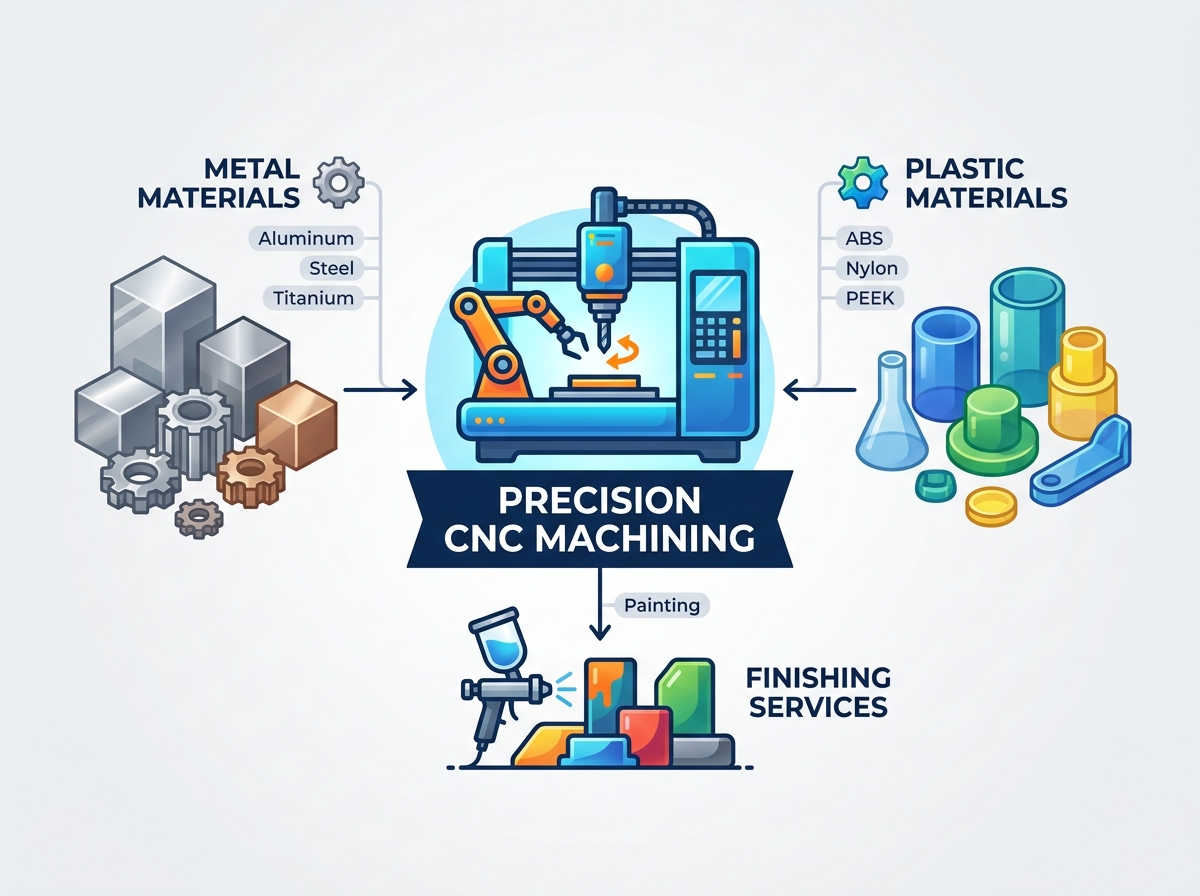
Selecting the right metal requires balancing mechanical needs with manufacturability. Partnering with expert Precision CNC machining services ensures you maximize the potential of these alloys while minimizing scrap rates.
Aluminum offers a high strength-to-weight ratio and excellent machinability. This leads to rapid production cycles and lower costs. Aluminum 6061 is highly versatile. It takes surface coatings exceptionally well, anodizes cleanly, and welds easily. Aluminum 7075 provides aerospace-grade strength, rivaling some steels. However, 7075 cannot be easily welded and carries a higher raw material cost. Both grades clear chips efficiently during milling and turning operations. When machining aluminum, high spindle speeds and aggressive feed rates are standard. Using polished, uncoated carbide end mills prevents the soft material from welding to the cutting flutes, a common issue known as built-up edge (BUE).
Stainless steel delivers superior corrosion resistance, distortion resistance, and high tensile strength. It thrives in harsh environments where standard carbon steel would quickly degrade. However, stainless steel is prone to work-hardening during machining. The material hardens as the cutting tool generates heat and friction. You must use rigid tooling setups and maintain a constant chip load. Allowing the tool to rub against the workpiece will instantly harden the surface, destroying the insert on the next pass. Optimized coolant strategies are mandatory to prevent tool chatter, manage heat generation, and avoid premature tool wear. 17-4 PH offers the added benefit of being precipitation-hardened after machining to achieve extreme strength.
These steels provide exceptional toughness and wear resistance. They are standard for structural components, shafts, and heavy machinery parts. Carbon and alloy steels often require post-machining heat treatment to achieve final hardness specifications. Dimensional changes occur during this heat treatment process due to metallurgical phase changes. You must factor these changes into pre-machining tolerances to ensure final dimensional accuracy. 4140 chromoly steel machines reasonably well in its annealed state but becomes significantly more challenging once hardened. Heavy roughing passes should be completed before heat treatment, leaving only a small amount of material for hard turning or grinding operations.
Titanium boasts an extreme strength-to-weight ratio. It offers exceptional corrosion resistance and biocompatibility. It is a staple in medical implants and aerospace structural components. Titanium has poor thermal conductivity. Heat concentrates on the cutting tool rather than dissipating into the chips. This thermal concentration rapidly degrades carbide inserts. Machining titanium requires low cutting speeds, high chip loads, and high-pressure coolant directed precisely at the cutting zone. You must avoid interrupted cuts whenever possible to prevent insert chipping. Machining titanium significantly increases production costs due to the slow material removal rates and high tooling consumption.
Nickel alloys provide extreme heat tolerance and oxidation resistance. They survive in high-temperature environments like jet engine turbines and chemical processing plants. They are extremely difficult to machine. Nickel alloys cause rapid work hardening and severe tool wear. You must use slow feeds, ultra-rigid setups, and high-performance tooling, often utilizing ceramic inserts for roughing passes. The cutting forces required are immense, demanding heavy-duty machine tools. Machining these alloys requires significant expertise, patience, and a robust budget for consumable tooling.
Brass offers unmatched machinability and excellent corrosion resistance. Pure copper provides maximum electrical and thermal conductivity. Brass acts as the industry benchmark for high-speed machining. It forms small, manageable chips that evacuate easily from deep pockets and tapped holes. Pure copper behaves entirely differently. It is gummy and difficult to break chips. Copper is highly prone to tool wrapping, where long, stringy chips tangle around the spindle and tooling. Machining pure copper requires specialized cutting geometries with high rake angles and abundant coolant to flush the sticky chips away from the cutting zone.
Material | Machinability Rating (Approx.) | Primary Advantage | Primary Challenge |
|---|---|---|---|
Brass (Alloy 360) | 100% (Benchmark) | High-speed machining | Lower tensile strength |
Aluminum 6061 | 270% | Versatility & Cost | Lower wear resistance |
Stainless Steel 304 | 45% | Corrosion resistance | Work-hardening |
Titanium Grade 5 | 15% - 20% | Strength-to-weight ratio | Poor thermal conductivity |
Inconel 718 | 10% | Extreme heat tolerance | Severe tool wear |
Engineering plastics offer unique advantages over metals, including weight reduction, electrical insulation, and chemical resistance. Utilizing dedicated Plastic CNC machining services ensures proper handling of these temperature-sensitive materials. Plastics require different workholding strategies to prevent crushing or deforming the raw stock before the machining even begins.
Acetal provides high dimensional stability, low moisture absorption, and low friction. It is ideal for gears, bearings, and sliding mechanisms where lubrication is impractical. Acetal machines very predictably. It forms crisp chips and holds tight tolerances easily. However, internal material stresses can cause warping. If material removal is highly asymmetrical, the part may distort after machining as the internal stresses release. Using stress-relieved extruded stock or incorporating roughing passes followed by a resting period can mitigate this distortion.
PEEK retains mechanical properties at extreme temperatures. It offers exceptional chemical resistance against harsh solvents and acids. PEEK often replaces metal in aerospace, automotive, and medical applications to save weight without sacrificing strength. The raw material cost is very high, making scrap extremely expensive. PEEK requires specialized annealing processes before machining. Sometimes it requires intermediate annealing during the machining process to prevent stress-induced cracking and dimensional shifts. Sharp tooling is mandatory to prevent heat buildup, which can melt the surface and ruin the finish.
Polycarbonate offers excellent impact resistance, structural rigidity, and optical clarity. PVC provides outstanding chemical resistance and flame retardancy. Heat generation during milling is a major issue for both of these polymers. Excessive heat causes melting, smearing, or burning of the plastic. You must use specific tooling geometries with high clearance angles to reduce friction. Air blasts or specialized liquid cooling strategies are necessary to maintain clear cuts, evacuate chips rapidly, and prevent material degradation. When machining polycarbonate for optical applications, vapor polishing is often required post-machining to restore complete transparency.
You must establish a clear decision framework when quoting a job. Sometimes it makes sense to buy a more expensive, highly machinable alloy. The savings on hourly machine rates often outweigh the higher raw material price. Aluminum costs more per pound than basic carbon steel but machines much faster, reducing the overall cycle time. Batch size heavily impacts this calculation. In prototyping, raw material cost is negligible compared to setup and programming time. In high-volume production, saving seconds per cycle yields massive cost reductions over thousands of parts. You must calculate the break-even point where material costs intersect with machining time savings.
Analyze the hourly rate of the specific CNC machine required for the job.
Compare the material removal rate (MRR) of the competing alloys.
Factor in the cost of consumable tooling for harder materials.
Calculate the total cycle time difference across the entire production run.
Aggressive material removal introduces stress into the workpiece. You must analyze the risk of part warping and distortion, especially on thin-walled components. Removing a large volume of material from one side of a block causes the remaining material to bow or twist. You can mitigate this by specifying stress-relieved material grades from the supplier. Incorporating roughing-and-resting cycles into the manufacturing plan also helps. This allows the material to relax and move before the final finishing passes lock in the critical dimensions. Flipping the part multiple times to remove material evenly from both sides is a standard machinist tactic to maintain flatness.
Finishing processes add functional and aesthetic value to the final component. You must plan for these operations during the material selection phase, as not all materials accept finishes equally. Experienced Metal CNC machining services can guide this planning to ensure the final product meets all specifications.
Different metals and plastics accept primers, paints, and powder coats differently. Aluminum anodizes beautifully, creating a hard, corrosion-resistant surface. Steel requires robust primers and surface preparation, such as sandblasting, to prevent rust from forming under the paint. Plastics present unique challenges for adhesion. Acetal has very low surface energy, making it notoriously difficult to paint or glue. Achieving adhesion on Acetal requires specialized chemical etching, flame treatment, or plasma treatments before applying any coating. Failing to prep the surface correctly will result in the paint flaking off during assembly or field use.
Coatings alter critical dimensions. You must address the implementation risk of Painting CNC machining parts. Paint, powder coats, and even heavy anodizing add measurable thickness to the part. You must mitigate this risk early in the engineering phase. Mask critical mating surfaces, threaded holes, and dowel pin locations to keep them bare. Alternatively, calculate the coating thickness into the initial CAD models. Paint typically adds 0.001" to 0.003" per surface. Adjust pre-machining dimensions accordingly to ensure parts fit together seamlessly after the finishing department completes their work.
Finish Type | Typical Thickness Added | Best Suited Materials |
|---|---|---|
Standard Anodizing (Type II) | 0.0002" - 0.001" | Aluminum |
Hardcoat Anodizing (Type III) | 0.001" - 0.002" | Aluminum |
Powder Coating | 0.002" - 0.006" | Steel, Aluminum |
Wet Paint | 0.001" - 0.003" | Metals, Prepped Plastics |
Select materials based on a strict evaluation of mechanical requirements, environmental exposure, and shop-floor manufacturability. Do not rely on theoretical properties without considering how the material behaves under a cutting tool. Review your tolerance requirements and adjust your CAD models to account for any secondary finishing operations.
Define your non-negotiable environmental constraints, such as chemical exposure or operating temperatures, to immediately eliminate unsuitable materials.
Calculate the break-even point between raw material costs and machining cycle times to find the most economical production path.
Adjust pre-machining dimensions on your blueprints to accommodate the specific thickness of your chosen surface finish.
Prototype complex geometries using highly machinable proxy materials to validate the tool paths and workholding strategies before cutting expensive alloys.
A: Aluminum 6061 is generally the most cost-effective material. It offers an optimal balance of low raw material cost and exceptionally high machinability. This allows for faster cutting speeds, reduced tool wear, and shorter machine times, significantly lowering overall production costs.
A: Contrast your weight and machinability needs against environmental requirements. Choose aluminum for lightweight parts and faster, cheaper machining. Choose stainless steel if the part requires high yield strength, distortion resistance, and superior corrosion resistance in harsh environments.
A: Acetal (Delrin) and PEEK hold the tightest tolerances. They feature high dimensional stability and very low moisture absorption. This prevents them from swelling or warping significantly during and after the machining process, ensuring consistent part dimensions.
A: Yes, paint adds measurable thickness to the part. This creates a tolerance stack-up issue. You must mask critical mating surfaces or adjust pre-machining dimensions in the CAD model to accommodate the typical 0.001" to 0.003" coating thickness per surface.
A: A machinability rating measures how easily a material can be cut compared to a baseline steel. It matters because it directly correlates to tool wear, cycle times, and final part cost. Higher ratings mean faster, cheaper production with fewer tool changes.
A: Yes, but they require specialized approaches. You must use specific carbide tooling, high-pressure coolant, and slower feed rates to manage intense heat and work-hardening. This makes machining them significantly more expensive and time-consuming than standard metals.


