
Views: 0 Author: Site Editor Publish Time: 2026-11-02 Origin: Site


Designing components that survive high-stress environments without shattering is a daily challenge on the engineering floor. Lightweight parts are highly sought after across multiple industrial sectors. This demand makes aluminum a go-to material for modern manufacturing. However, not all aluminum behaves the same under extreme mechanical pressure. Understanding the exact meaning ductile materials bring to a structural assembly is what ultimately prevents catastrophic system failures.
In this comprehensive technical guide, we will explore how ductility impacts cast components. We will examine how quality control engineers measure it in the lab and how specific manufacturing methods dictate the final product's performance on the field.
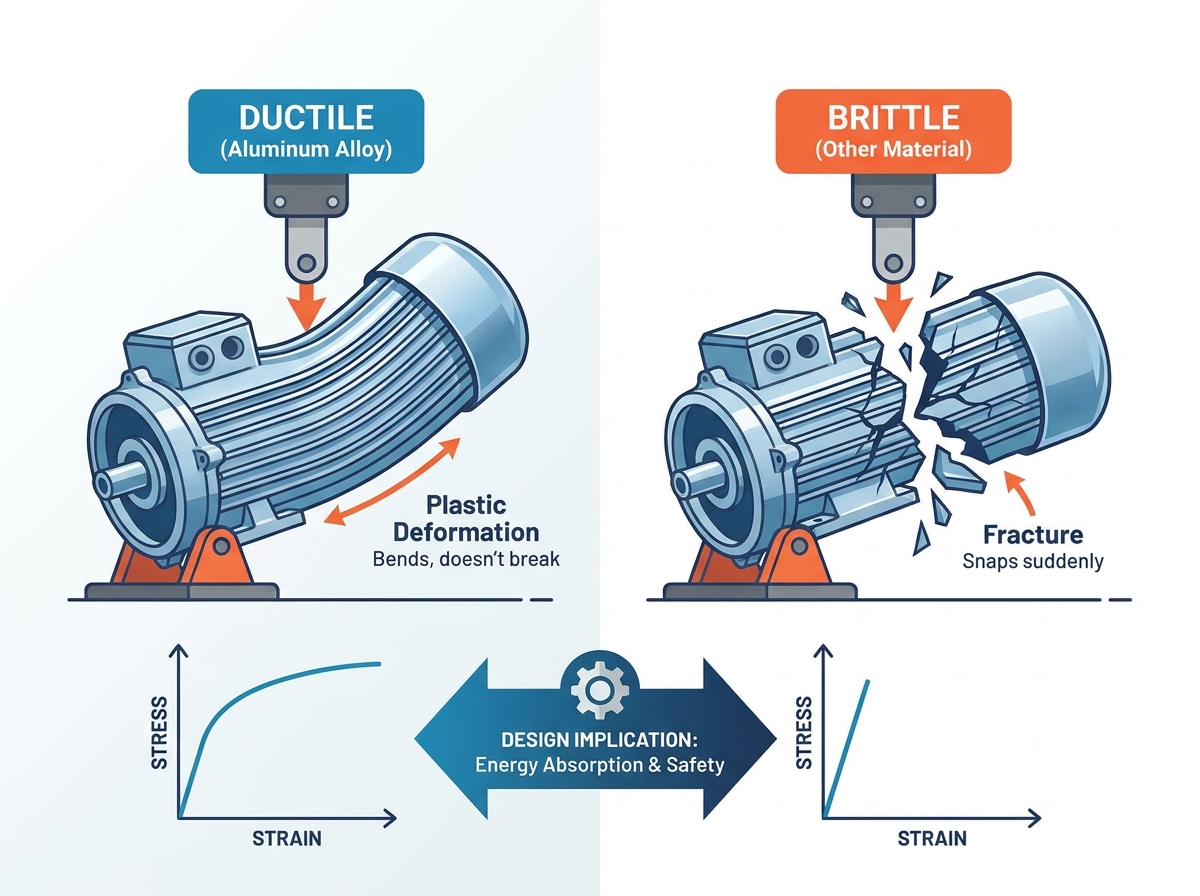
Core Definition: The meaning ductile refers to a material's inherent ability to undergo significant plastic deformation under tensile stress before rupturing. It is the capacity to stretch safely rather than snap suddenly.
Laboratory Testing: Implementing rigorous laboratory testing using universal tensile machines is critical. Engineers must quantify elongation percentages and yield strength to ensure the final component aligns with stringent safety regulations.
Manufacturing Methods: Advanced solidification techniques, such as squeeze processes, drastically minimize internal gas porosity. This elevates the ductility and structural integrity of the finished part.
Real-World Applications: High-stress operational environments depend on highly ductile alloys. These materials accommodate thermal expansion and continuous mechanical vibrations without initiating fatigue cracks.
On the factory floor, ductility is a mechanical property that describes the extent to which a solid material can sustain plastic deformation without fracturing. When a tensile load is applied, a ductile material will elongate. It reduces in cross-sectional area before ultimately failing. This behavior is visually represented on a stress-strain curve, where a ductile metal exhibits a wide plastic region following its elastic limit.
Conversely, brittleness is the exact opposite. A brittle material absorbs very little energy prior to fracture. Materials like cast iron or standard ceramics simply snap. When subjected to stress that exceeds its yield strength, a brittle material shatters with almost zero plastic deformation. For industrial designers and mechanical engineers, grasping the meaning ductile materials bring to a project is fundamental. A ductile material will bend and stretch to absorb kinetic energy. A brittle material will break suddenly and without warning, often taking the rest of the mechanical assembly down with it.
Recent industry analyses highlight a massive shift toward structural lightweighting. Driven primarily by the electric vehicle and aerospace sectors, engineers are aggressively stripping away excess weight to extend battery range and improve fuel efficiency. Current engineering trends show a surge in demand for large-scale structural castings, often referred to as gigacastings. In these massive components, ductility is not just a preference; it is a strict regulatory requirement.
As parts get thinner and lighter, they must still absorb immense crash energy. This industry-wide pivot underscores why high-ductility aluminum is replacing traditional heavy steel assemblies. Because ductile materials deform visibly before they reach their ultimate tensile strength, they provide a built-in warning system. If a sudden overload occurs, the component will bend or warp. This physical distortion alerts maintenance teams to the impending failure before a catastrophic rupture happens. By specifying materials with high ductility, engineers ensure that components can absorb unexpected impact loads safely.
When specifying aluminum alloy casting parts for dynamic industrial applications, ductility dictates how the component will handle kinetic energy and impact forces. In active mechanical systems, parts are frequently subjected to sudden impacts or unexpected load spikes. A casting with high ductility can absorb this kinetic energy by converting it into plastic deformation.
Instead of the energy causing an immediate fracture, the atomic structure of the ductile aluminum allows dislocations to move smoothly through the crystal lattice. This internal movement absorbs the stress. Consequently, the structural integrity of the broader mechanical system is preserved, even if the individual component undergoes slight dimensional changes. This energy-absorbing capability is exactly what makes ductile aluminum indispensable in crash-management systems, suspension components, and heavy-duty brackets.
Beyond sudden impacts, ductility plays a vital role in preventing fatigue failures over time. Mechanical components often endure cyclic loading, which consists of repeated stress patterns that occur during standard operation. Over thousands or millions of cycles, microscopic stress concentrations can initiate micro-cracks in the metal.
In brittle materials, these micro-cracks propagate rapidly through the part. This leads to sudden failure. However, in highly ductile aluminum alloys, the material at the tip of the micro-crack undergoes localized plastic deformation. This deformation effectively blunts the crack tip. It reduces the stress concentration and slows down the propagation of the fracture. By inhibiting crack growth, ductility significantly extends the operational lifespan and reliability of cast aluminum components under cyclic loads.
Ductility is not merely a qualitative concept; it is a strictly measurable mechanical property. The primary metric used to quantify ductility is the percentage of elongation at the point of fracture. During testing, a standardized specimen is pulled apart, and the increase in length is measured against its original gauge length. A higher elongation percentage directly correlates with higher ductility.
Another critical metric is yield strength. This marks the exact point where elastic, reversible deformation ends and permanent plastic deformation begins. The gap between the yield strength and the ultimate tensile strength represents the material's working ductile range.
Mechanical Property | Engineering Definition | Implication for Ductility |
|---|---|---|
Yield Strength | The exact stress level at which permanent deformation begins. | Determines the load threshold before ductile stretching occurs. |
Ultimate Tensile Strength | The maximum stress a material can withstand before breaking. | Defines the absolute upper limit of the material's load-bearing capacity. |
Elongation % | The percentage of stretch a part undergoes before fracture. | The primary empirical indicator of a material's ductility. |
To guarantee that a material meets these specific mechanical requirements, professional foundries rely on formal casting tensile strength testing. This process is typically conducted according to strict international standards, such as ASTM E8. A machined sample of the cast aluminum is placed into a universal testing machine. The machine applies a continuous tensile pull while highly sensitive sensors record the force applied and the amount of stretch until the sample breaks.
Top-tier manufacturing facilities integrate this testing into comprehensive quality control protocols alongside X-ray flaw detectors and spectrometers. By measuring the exact elongation and yield strength of samples from each casting batch, engineers can empirically verify that the metallurgical structure is sound. If a batch shows lower-than-expected elongation, it points to potential issues like excessive gas porosity or alloy contamination. Catching this early prevents substandard parts from entering mass production.
The manufacturing process used to create an aluminum component has a profound impact on its final ductility. Utilizing aluminum squeeze casting is an advanced manufacturing technique that combines the best elements of both casting and forging. During this process, molten aluminum is poured into a preheated die, and immense hydraulic pressure is applied as the metal solidifies.
This applied pressure serves a crucial metallurgical function. It forcefully compresses the solidifying metal, effectively eliminating gas porosity and shrinkage cavities that naturally occur as aluminum cools. Because internal voids act as stress concentrators that initiate premature brittle failure, removing them results in a significantly denser microstructure. Consequently, squeeze-cast parts exhibit exceptional ductility and high tensile strength. Furthermore, these dense parts are fully capable of undergoing aggressive T6 heat treatments without surface blistering.
Traditional High-Pressure Die Casting is favored for its ability to produce complex geometries rapidly and cost-effectively. However, standard die casting injects molten metal into the die cavity at extremely high velocities. This turbulent flow can trap air and casting lubricants inside the metal, leading to internal gas porosity.
While these parts possess excellent dimensional accuracy, the trapped gases often limit their overall ductility. Standard die-cast parts generally cannot be subjected to high-temperature heat treatments, as the trapped gases will expand and destroy the part. To achieve high ductility in die casting environments, manufacturers must utilize specialized vacuum-assisted techniques to minimize turbulence and gas entrapment.
When ductility is a primary design requirement, material selection is paramount. The A356 aluminum alloy is widely regarded as the gold standard for structural castings. Composed primarily of aluminum, silicon, and magnesium, A356 offers excellent castability and corrosion resistance. As automotive engineers push for longer ranges and higher safety ratings, the demand for A356-T6 has surged because it pairs low weight with exceptional elongation.
Its true potential is unlocked through the T6 heat treatment process. This involves solution heat treating the part at a high temperature to dissolve alloying elements into a solid solution, rapidly quenching it in water, and then artificially aging it. The T6 temper optimizes the precipitation of strengthening phases within the aluminum matrix. For example, properly treated A356-T6 can achieve a yield strength exceeding 220 MPa while maintaining an elongation percentage that typically ranges from 7% to 10%.
Not all aluminum alloys are formulated for ductility. Engineers must constantly weigh mechanical properties against castability and production costs. Use the following baseline to match your project requirements to the right alloy.
Alloy Grade | Primary Characteristics | Typical Ductility Elongation | Best Engineering Use Case |
|---|---|---|---|
A356-T6 | High strength, excellent ductility, fully heat-treatable. | 7% - 10% | Structural parts, safety components, new energy vehicle motor housings. |
A380 | Good castability, cost-effective, decent thermal properties. | 2% - 3% | General consumer goods, static brackets, electronics housings. |
ADC12 | Excellent fluidity, ideal for complex thin-wall geometries. | 1% - 2% | Intricate automotive parts where high ductility is not required. |
As the data indicates, alloys like A380 and ADC12 are chosen for their ease of casting in high-volume environments. However, their low elongation percentages make them unsuitable for applications requiring high ductility and impact resistance.
An electric motor housing is not merely a protective shell; it is an active structural component subjected to severe operational stresses. Specifying an aluminum motor housing casting means the part must endure constant mechanical vibration generated by the rotor, high torque loads during acceleration, and potential external impacts.
If the housing is manufactured from a brittle alloy, the continuous high-frequency vibrations can induce fatigue cracking over time. A ductile alloy, however, can absorb these micro-vibrations and distribute the torque stresses across the housing geometry. This prevents the initiation of fatigue cracks near mounting points and bearing supports, ensuring the motor operates safely over its intended lifecycle.
In addition to mechanical stress, motor housings are subjected to intense thermal cycling. As the motor operates, electrical resistance and friction generate significant heat. This heat causes the aluminum housing to expand. When the motor is powered down, the housing cools and contracts.
Ductile aluminum alloys are uniquely equipped to handle this thermal expansion and contraction. Their ability to undergo slight plastic deformation allows them to accommodate dimensional changes without warping, cracking, or compromising the tight tolerances required for the stator and rotor alignment. This thermal stability is a primary reason why high-ductility alloys, specifically A356-T6, are specified for advanced automotive and industrial motors.
Engineers must recognize that material properties are not solely determined by the chosen alloy. The physical geometry of the part heavily influences the cooling rate, solidification dynamics, and ultimately, the mechanical behavior of the final component. By adhering to strict geometric principles, product designers can ensure their components maintain structural integrity under extreme stress.
Uniform wall thickness is a fundamental principle in casting design. When a component features abrupt changes in cross-sectional area, the molten aluminum cools at significantly different rates. Thinner sections solidify rapidly, while thicker sections remain molten for a longer duration. This differential cooling creates internal thermal stresses and localized shrinkage porosity.
To maximize ductility, designers should maintain uniform wall thicknesses wherever physically possible. If structural transitions are unavoidable, they must be engineered to be gradual rather than abrupt. Achieving a smaller secondary dendrite arm spacing through optimal cooling yields higher tensile strength and superior elongation properties.
Sharp internal corners are highly detrimental to ductile performance. In mechanical engineering, sharp corners act as severe stress concentrators. When tensile stress is applied, the structural force lines converge at these sharp geometries, amplifying the local stress exponentially. Even if the base aluminum alloy possesses excellent inherent ductility, a sharp corner can initiate a microscopic crack prematurely.
Implementing generous fillets and radii distributes the applied load over a much larger surface area. This distribution allows the aluminum matrix to absorb kinetic energy and deform safely. Even a small increase in the fillet radius can drastically reduce localized stress and prevent fatigue failure.
The gating system dictates exactly how molten aluminum enters the die cavity. If the metal velocity is too high, it causes severe turbulence. This exposes the molten aluminum to ambient air, leading to the rapid formation of aluminum oxide films. These microscopic oxide bifilms become trapped within the solidifying metal matrix.
These bifilms act as pre-existing two-dimensional defects with zero tensile strength. To maintain the ductile characteristics of the alloy, the gating system must be meticulously designed to promote laminar flow. Computational fluid dynamics simulation software is routinely used by top foundries to optimize gate sizing and runner geometry, eliminating the turbulence that causes oxide entrapment.
Understanding the fundamental meaning ductile properties bring to metallurgy is the cornerstone of designing safe, durable, and high-performing aluminum components. From absorbing sudden impacts in crash structures to resisting fatigue under cyclic loads in motor housings, ductility serves as a vital safeguard against catastrophic mechanical failure.
By carefully selecting the appropriate heat-treatable alloy, such as A356-T6, and pairing it with advanced manufacturing techniques that compress internal voids, engineers can maximize elongation and part reliability. Ultimately, combining intelligent geometric design with rigorous laboratory testing ensures that your aluminum castings will perform predictably in even the most demanding environments.
When planning your next high-stress project, prioritizing ductility through expert manufacturing partnerships is the most effective strategy for long-term engineering success. If you are looking to develop lightweight, high-strength structural components, explore the advanced casting solutions and rigorous quality control standards available at QSY Casting to ensure your parts meet the highest industry benchmarks.
In the precise context of aluminum casting, the meaning ductile refers to the material's inherent capacity to undergo significant plastic deformation before fracturing. When a mechanical load exceeds the material's yield strength, a ductile aluminum part will stretch, bend, or deform rather than snapping abruptly. This characteristic serves as a critical safety buffer in structural engineering. For example, in automotive crash structures, ductile aluminum absorbs kinetic energy through controlled deformation, protecting the occupants. If the material were brittle, it would shatter upon impact, offering zero energy absorption.
Yes, aluminum squeeze casting significantly improves the overall ductility of the final component when compared to traditional die casting methods. The process involves pouring molten aluminum into a preheated die and applying immense hydraulic pressure while the metal solidifies. This sustained high pressure fundamentally alters the solidification dynamics. It forces the molten metal into every micro-crevice of the die and compresses any internal hydrogen gas or shrinkage voids. By effectively eliminating internal porosity, the resulting aluminum matrix is incredibly dense and continuous, which is essential for maximum ductility.
Increasing the ductility of cast aluminum requires a combination of precise alloy chemistry, optimized casting processes, and post-casting thermal management. First, selecting an alloy with low iron content, such as primary A356, prevents the formation of brittle iron-rich intermetallic phases. Second, utilizing vacuum-assisted casting or squeeze casting eliminates internal gas porosity, which acts as crack initiation sites. Finally, applying a proper T6 heat treatment spheroidizes the silicon particles within the aluminum matrix, transforming sharp, brittle flakes into rounded particles that allow the metal to stretch significantly before failing.
Generally, extruded or forged aluminum exhibits higher ductility than standard cast aluminum. Forging and extrusion processes physically knead and align the grain structure of the metal under immense pressure, eliminating all internal voids and creating a highly continuous, directional grain flow. Standard casting processes naturally introduce microscopic porosity and a random grain structure as the liquid metal cools and shrinks. However, advanced casting techniques like squeeze casting, combined with T6 heat treatment, can produce cast components with ductility levels that closely rival those of forged parts, offering a highly cost-effective alternative for complex geometries.
The A356-T6 alloy is widely considered the premier choice for aluminum motor housing casting because it offers an exceptional balance of high tensile strength, superior heat dissipation, and excellent ductility. Both electric and internal combustion motors generate constant, high-frequency vibrations and substantial thermal loads during operation. A brittle material would quickly develop severe fatigue cracks under these continuous cyclical stresses. The A356 alloy, particularly when optimized through the rigorous T6 heat treatment process, develops a highly refined microstructure that can easily absorb mechanical vibrations and accommodate thermal expansion without fracturing.


