
Views: 0 Author: Site Editor Publish Time: 2026-10-19 Origin: Site


Manufacturing a high-performance metal component rarely concludes the moment molten alloy solidifies inside a mold. Engineers and product designers face an immediate, insidious challenge right off the production line. They must protect the raw part from environmental degradation. Without an appropriate metal casting surface treatment, freshly minted parts remain highly susceptible to rapid oxidation. They also suffer from abrasive wear and chemical attack when deployed in harsh industrial settings. Ultimately, the methodology chosen to seal and harden these components dictates their operational lifespan and functional reliability.
Among the myriad of finishing technologies available today, nickel plating establishes itself as a remarkably versatile and robust solution. It engineers a dense, protective shell. This barrier isolates vulnerable base metals from corrosive elements while significantly upgrading surface hardness. Integrating this finish is not a universal plug-and-play process. Different substrates react uniquely to chemical plating baths. This guide explores the precise scenarios where nickel plating becomes an engineering necessity, focusing specifically on the intricate pre-treatment protocols required for aluminum and zinc alloys.
Engineering Versatility: Nickel plating delivers a rare combination of superior corrosion resistance, mechanical wear reduction, and aesthetic flexibility.
Material Specificity: It serves as an exceptional upgrade for zinc alloys requiring high-gloss decorative finishes or extreme surface durability in demanding environments.
Crucial Pre-treatments: Direct application is scientifically impossible for certain reactive metals. Coating aluminum or zinc mandates highly controlled chemical pre-treatments like zincating or copper strikes to guarantee metallurgical adhesion.
The Electroless Advantage: Electroless deposition builds with flawless uniformity. It represents the ultimate solution for complex geometries, deep blind holes, and precision internal threads.
Strategic Investment: Commanding a premium over basic coatings, nickel plating remains the definitive choice for projects prioritizing long-term structural integrity and strict dimensional accuracy.
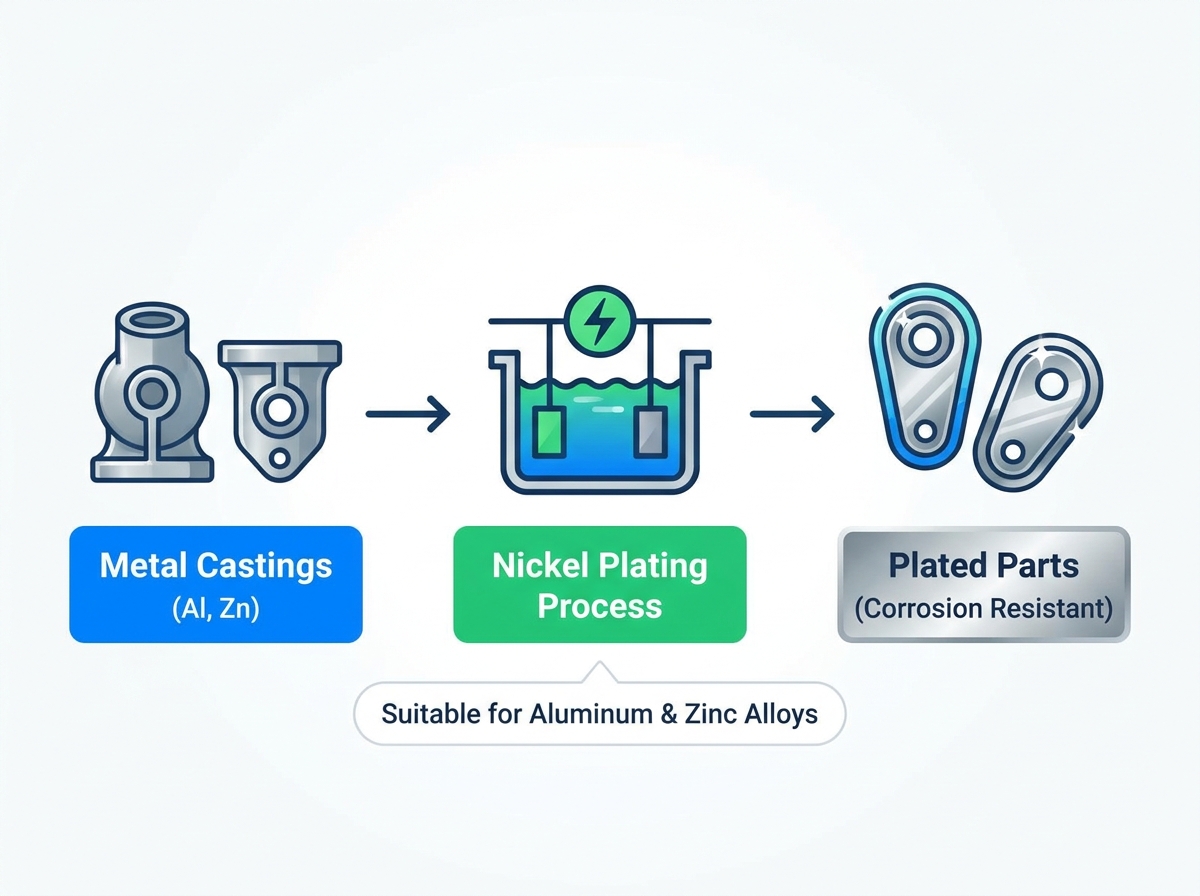
To make an informed specification, procurement teams must first demystify the mechanics of the plating process. At its core, nickel plating involves depositing a microscopic, durable layer of metal onto a substrate. Cast metals inherently feature microscopic porosity, intricate contours, and varying metallurgical compositions. Therefore, the specific deposition technique makes all the difference in field performance.
In the industrial sphere, engineers typically evaluate two distinct methodologies: electrolytic and electroless plating.
Electroplating: This traditional approach utilizes an external electrical current to drive nickel ions from a sacrificial anode through an electrolyte bath onto the cast part. It proves highly efficient for producing brilliant, mirror-like finishes on straightforward geometries. Yet, it possesses a critical flaw for complex engineering. The electrical current naturally concentrates on sharp edges and external points. Consequently, this creates edge buildup. A thicker coating forms on the exterior while leaving deep recesses and internal cavities dangerously under-plated.
Electroless Nickel Plating: In stark contrast, electroless plating is an autocatalytic chemical process. It eliminates the need for external electricity entirely. Deposition triggers purely through a controlled chemical reduction reaction upon contact with the part surface. For intricate metal castings, this process is revolutionary. Because it ignores electrical current density, the nickel-phosphorus alloy builds up with absolute mathematical uniformity. A complex hydraulic manifold receives the exact same micron-level thickness in its deepest internal channels as it does on its flat exterior faces.
Furthermore, this uniform coverage seals the microscopic surface voids often found in die cast or sand cast components. It effectively bridges small pores to form an impenetrable moisture barrier.
Selecting a surface finish requires a calculated evaluation of the specific mechanical and environmental stressors a part will endure. Nickel plating frequently edges out competing coatings by neutralizing multiple failure modes simultaneously.
The primary mandate of any coating is isolation. Nickel naturally resists oxidation and degradation when exposed to moisture, mild acids, and atmospheric pollutants. When engineers specify high-phosphorus electroless nickel containing 10 to 14 percent phosphorus, the resulting finish features an amorphous, glass-like microstructure. This effectively eliminates the grain boundaries where corrosion typically initiates. Such components routinely survive hundreds of hours in rigorous ASTM B117 salt spray testing without yielding to red rust. This makes them indispensable in marine and chemical processing sectors.
Many lightweight cast metals possess excellent structural strength but suffer from soft surfaces. Subjected to sliding friction, they are prone to galling and abrasive wear. Nickel plating fundamentally alters this dynamic. Raw aluminum might hover around 150 Vickers hardness. A standard electroless layer instantly elevates that surface to a range of 500 to 700 Vickers hardness. If the application demands extreme durability, post-plating heat treatments baking the part at roughly 400 degrees Celsius can push the hardness beyond 1000 Vickers hardness. This phenomenal surface hardening drastically extends the operational life of gears, rotors, and interlocking assemblies.
Recent market analyses indicate a massive pivot toward advanced nickel-phosphorus coatings. This shift is heavily driven by the electric vehicle and aerospace sectors. Manufacturers aggressively pursue lightweighting to extend battery range and improve fuel efficiency. They are rapidly substituting heavy steel components with lighter aluminum and zinc alloy casting parts. However, these lighter metals require robust surface hardening to survive high-stress environments. Consequently, demand for precision electroless nickel plating has surged. It allows engineers to marry the low mass of aluminum with the surface durability of hardened steel while adhering to stringent environmental longevity standards.
Despite its impressive properties, nickel cannot simply be painted onto any raw metal. Base material chemistry dictates the entire finishing strategy. Applying a durable coat requires meticulous engineering and highly specialized pre-treatment protocols.
Zinc alloys, particularly the Zamak series, are prized for their low melting points, exceptional dimensional stability, and ability to cast incredibly thin walls. For instance, fluid handling components like a Zamak 5 Flanged Pipe Connector require strict tolerance control for leak-proof sealing. Unfortunately, raw zinc is highly reactive. Left exposed, it quickly develops a powdery white corrosion.
Directly submerging a zinc component into a standard acidic nickel bath is a recipe for disaster. The zinc rapidly dissolves, contaminating the chemistry and yielding a blistered, useless finish. To circumvent this, technicians employ a critical intermediate step known as the copper strike. By first electroplating a microscopic, dense layer of alkaline copper onto the casting, they create a protective chemical barrier. This copper foundation is completely inert to the subsequent nickel bath, ensuring flawless metallurgical adhesion. When executed correctly, plated zinc alloy die casting parts offer a hefty, premium feel alongside outstanding longevity.
Aluminum presents an entirely different metallurgical hurdle. The exact moment a freshly machined aluminum part is exposed to oxygen, it forms a tenacious, microscopic oxide skin. This natural barrier acts as an excellent insulator but instantly repels standard plating metals. It prevents them from bonding to the underlying substrate.
To successfully plate aluminum, manufacturers utilize the zincate process. The casting is immersed in a highly alkaline solution. This simultaneously strips away the stubborn oxide layer and deposits a temporary microscopic shield of pure zinc. This zinc layer prevents re-oxidation as the part transfers to the electroless nickel bath. Once submerged, the nickel chemically replaces the zinc, bonding directly and permanently to the raw aluminum beneath.
For procurement managers and lead engineers making critical bottom-of-funnel decisions, evaluating nickel against alternative industrial coatings is essential to maximize return on investment.
Surface Treatment | Corrosion Resistance | Wear Resistance & Hardness | Dimensional Accuracy | Best Application Scenarios |
|---|---|---|---|---|
Electroless Nickel Plating | Excellent due to pore-free barrier | High reaching up to 1000 Vickers hardness | Exceptional with uniform micron control | Complex geometries, internal threads, harsh environments |
Hard Chrome Plating | Moderate due to micro-cracked surface | Very High exceeding 1000 Vickers hardness | Poor due to edge buildup and low throwing power | Simple cylindrical shafts, extreme abrasive wear |
Anodizing for Aluminum | Good | Moderate to High for Hardcoat | Good | Cosmetic aluminum parts, electrical insulation needs |
Powder Coating | Good if unchipped | Low relying on a polymer barrier | Very Poor adding 50 to 150 microns unevenly | Cost-effective exterior housings, non-precision parts |
Specifically, hard chrome is legendary for abrasive wear resistance but suffers from terrible throwing power. It struggles to coat deep recesses. Corrosive fluids can easily seep through its microscopic fissures. Anodizing converts the aluminum surface into a hardened oxide, but this layer is a strict electrical insulator. If your component requires electrical grounding or electromagnetic interference shielding, anodizing will fail completely. Powder coating bakes a thick polymer barrier over the metal, which can easily ruin tight engineering tolerances or clog fine machine threads. In contrast, nickel plating bonds at a molecular level. It can be controlled down to single-digit microns, preserving the exact precision of CNC-machined castings.
The theoretical benefits of this finishing process translate into tangible performance advantages across some of the world's most demanding industries.
In environments where mechanical failure is catastrophic, nickel-plated castings are ubiquitous. Transmission gears, hydraulic actuator bodies, and fuel system housings rely heavily on this treatment. The uniform thickness ensures that precision aerospace valves maintain their exact fluid dynamic properties. Simultaneously, the hardened surface prevents the galling of moving parts under high-frequency vibration.
The telecommunications and electronics sectors are massive consumers of die cast parts. Devices such as fiber optic transceivers, ruggedized military radios, and RF connectors require enclosures that offer both structural rigidity and robust electromagnetic shielding. Nickel plating provides a conductive, corrosion-resistant shell. This protects sensitive internal microprocessors from environmental moisture and signal interference.
Cast components deployed in fluid handling face relentless exposure to abrasive slurries and aggressive chemicals. Pump impellers, pipe connectors, and industrial valves benefit immensely from a high-phosphorus nickel coating. It provides a smooth, low-friction internal surface that actually improves fluid dynamics while shielding the underlying cast iron or brass from cavitation erosion and chloride stress corrosion.
Specifying this finish requires foresight. Design teams must evaluate several critical parameters during the prototyping phase to prevent costly manufacturing defects down the line.
It is imperative to remember that plating adds physical material to the exterior of the component. A specified coating of 20 microns will add 20 microns to every exposed surface. Consequently, the diameter of an internal bore will shrink by 40 microns, while an external shaft will grow by the same amount. Mechanical engineers must calculate this exact buildup into their initial CAD models to guarantee that tight-tolerance mating parts assemble correctly post-plating.
A surface treatment can never outshine the quality of the substrate beneath it. If a die casting process traps excessive gases, it results in sub-surface porosity. When such a porous casting enters the heated chemical baths of a plating line, those trapped gases expand and force their way out. This phenomenon causes the newly deposited nickel layer to blister, pit, or experience spotting out weeks after production. Achieving a flawless finish absolutely requires a dense, high-quality raw casting.
Driven by the cost of raw nickel, complex chemical baths, and multi-step pre-treatments, this process carries a higher upfront price tag than basic clear chromate or powder coating. Procurement teams must evaluate the Total Cost of Ownership. If a budget finish allows a critical component to fail in the field prematurely, the resulting warranty claims and maintenance downtime will dwarf the initial premium paid for proper plating. For mission-critical parts, the return on investment is undeniable.
Securing a resilient, visually flawless finish requires rigorous quality control and seamless coordination between the foundry and the plating facility.
The final plated surface acts as a magnifying glass for the raw casting condition. Rough machining marks, deep scratches, or prominent parting lines will only be highlighted by bright nickel. Meticulous mechanical preparation is non-negotiable. Vibratory tumbling, fine buffing, and intense ultrasonic cleaning ensure the metal is entirely free of casting release agents, cutting fluids, and localized oxides before it ever touches a plating bath.
The most frequent point of failure in industrial finishing occurs during the handoff between a casting supplier and a third-party plating vendor. Miscommunications regarding alloy chemistry or tolerance stacking often lead to finger-pointing when defects arise. To mitigate this risk, buyers should partner with a comprehensive manufacturer possessing deep expertise in both metallurgical casting and surface finishing chemistry. A unified, single-source approach ensures casting parameters are optimized from day one specifically to receive a high-quality plate.
In the demanding world of industrial manufacturing, nickel plating stands out as an exceptionally effective surface treatment. It transforms vulnerable raw metals into highly durable, corrosion-resistant components. By bridging the gap between mechanical performance and aesthetic appeal, it solves multiple engineering challenges simultaneously.
For projects utilizing aluminum and zinc alloys, this finish is not just suitable, it is highly recommended. When your application demands uncompromising dimensional accuracy, complex geometry coverage, and long-term environmental resilience, the strategic application of nickel provides unmatched value.
Do not leave the lifespan of your critical components to chance. Evaluate your specific performance requirements and match them with the right manufacturing expertise. Visit QSY Casting today to explore premium aluminum and zinc alloy casting solutions, and discover exactly how precision surface treatments can elevate your product reliability to the next level.
No, applying nickel directly to raw zinc is chemically unviable. The acidic nature of standard nickel baths will aggressively attack and dissolve the zinc substrate, ruining both the part and the chemical solution. To achieve a successful bond, manufacturers must first apply a copper strike. This very thin, dense layer of electroplated copper acts as a protective barrier. It prevents adverse reactions and promotes exceptional metallurgical adhesion for the final nickel layer.
The optimal choice depends entirely on your specific engineering requirements. While anodizing is a fantastic, durable finish for aluminum, it cannot be applied to zinc alloys. Nickel plating is compatible with both. Furthermore, nickel offers superior wear resistance against sliding friction and remains highly electrically conductive. In contrast, anodizing converts the surface into an aluminum oxide, which acts as a strict electrical insulator, making it unsuitable for parts requiring grounding or electromagnetic interference shielding.
When applied correctly over a properly prepared, dense casting, a high-quality electroless nickel finish can last for decades. Its ultimate lifespan is dictated by the specific thickness of the deposit and the phosphorus content of the alloy. High-phosphorus electroless nickel is explicitly engineered to withstand years of continuous exposure in extremely harsh, corrosive environments, including marine and chemical processing applications.
Yes, all plating processes inherently add a physical layer of material to the exterior of the component. However, electroless nickel plating is highly regarded because it deposits this layer with absolute uniformity across all surfaces, including deep blind holes and intricate threads. Because the thickness is predictable and typically measured in exact microns, mechanical engineers can easily factor this precise buildup into their initial CAD designs. This ensures tight machining tolerances are maintained without issue.
Electroless nickel plating generally carries a higher upfront cost compared to basic finishes like powder coating, clear chromate, or standard anodizing. The pricing reflects the complex chemical baths, required pre-treatments like zincating or copper strikes, and the cost of raw nickel. However, when evaluating the Total Cost of Ownership for precision engineering parts, the extended lifespan, wear resistance, and elimination of corrosion-related field failures often make it the most cost-effective long-term investment.
Plating a highly porous casting is extremely difficult and generally ill-advised. Sub-surface porosity traps casting gases and machining fluids. When the part enters the heated chemical baths during the plating process, these trapped substances expand and force their way to the surface. This inevitably leads to blistering, pitting, or spotting out on the finished nickel layer. For a flawless and durable plated finish, starting with a dense, high-quality raw casting is an absolute requirement.


