
Views: 0 Author: Site Editor Publish Time: 2026-10-05 Origin: Site


Struggling to combine the intricate geometric complexity of die casting with the sheer mechanical strength of a forged billet? This common engineering headache plagues product designers and procurement managers alike. Squeeze casting solves this exact manufacturing challenge. Frequently referred to as liquid metal forging, this advanced technique applies massive, sustained pressure during the solidification phase. The result is a highly refined internal structure that effectively eliminates internal porosity and shrinkage voids.
For engineering teams operating at the bottom of the decision-making funnel, the critical question goes beyond simply understanding the process. You must determine whether your specific components justify the transition. This comprehensive guide explores the primary applications of high-pressure solidification. From safety-critical automotive suspension nodes to complex industrial valves, discover exactly which parts benefit the most from this advanced manufacturing technique.
Zero Porosity and High Strength: The process produces exceptionally dense, heat-treatable components that closely rival forged parts in both mechanical integrity and fatigue resistance.
EV and Automotive Dominance: The rapid transition to electric vehicles makes structural chassis nodes and lightweight suspension parts prime candidates for this methodology.
Cost-Effective for Complex Geometries: It offers a highly economical alternative to traditional forging for parts requiring intricate internal features and minimal secondary CNC machining.
Versatile Material Compatibility: While zinc and magnesium are highly compatible, aluminum alloys experience the most dramatic metallurgical performance gains, particularly A356-T6.
Recent industry analyses reveal a decisive pivot in global manufacturing strategies. As stringent emission standards and electric vehicle range targets dominate the engineering landscape, the demand for high-integrity lightweight components is surging. Market trends indicate that advanced liquid metal forging is rapidly capturing market share from traditional steel stamping and iron casting. Engineers are no longer willing to compromise between weight reduction and crashworthiness. By consolidating multi-piece weldments into single, high-strength aluminum nodes, manufacturers achieve unprecedented mass reduction while maintaining structural rigidity. This macro-trend pushes high-pressure solidification from a niche aerospace process into mainstream high-volume production.
Before analyzing specific industry use cases, we must establish why certain engineering applications demand this specific manufacturing route. Liquid metal forging bridges the historical gap between traditional sand pouring and mechanical forging. Grasping these underlying metallurgical benefits helps procurement managers identify projects that justify the initial tooling investment.
Traditional High-Pressure Die Casting injects molten metal into a steel cavity at extreme velocities, often exceeding 40 meters per second. This turbulent flow inevitably traps air and creates micro-shrinkage voids as the metal cools. Squeeze casting fundamentally alters this dynamic. It introduces the molten material at a much lower velocity to maintain laminar flow. Subsequently, massive hydraulic pressure—often exceeding 100 MPa—is applied throughout the entire freezing phase. This relentless force pushes the molten metal into every microscopic crevice of the die. It actively feeds the shrinkage and completely prevents gas pocket formation. The resulting microstructure is fully dense. This density is an absolute necessity for parts subjected to high dynamic loads.
One frustrating limitation of standard die-cast parts is their inability to undergo high-temperature precipitation hardening. Subjecting a standard part to a T6 heat treatment causes trapped internal gas pockets to rapidly expand. The surface blisters aggressively, destroying structural integrity. Because aluminum squeeze casting completely eliminates these internal air pockets, the components safely undergo full T6 thermal processing. This treatment alters the grain structure, drastically elevating tensile and yield strength to levels remarkably close to forged counterparts.
Forging produces incredibly strong parts but struggles with complex internal geometries or thin-walled sections. Forged blanks often require extensive secondary CNC machining to achieve final dimensional tolerances. High-pressure solidification excels at near-net shape manufacturing. The intense pressure ensures excellent replication of intricate die details. This delivers superior surface finishes right out of the mold, minimizing raw material waste and slashing expensive machining cycle times.
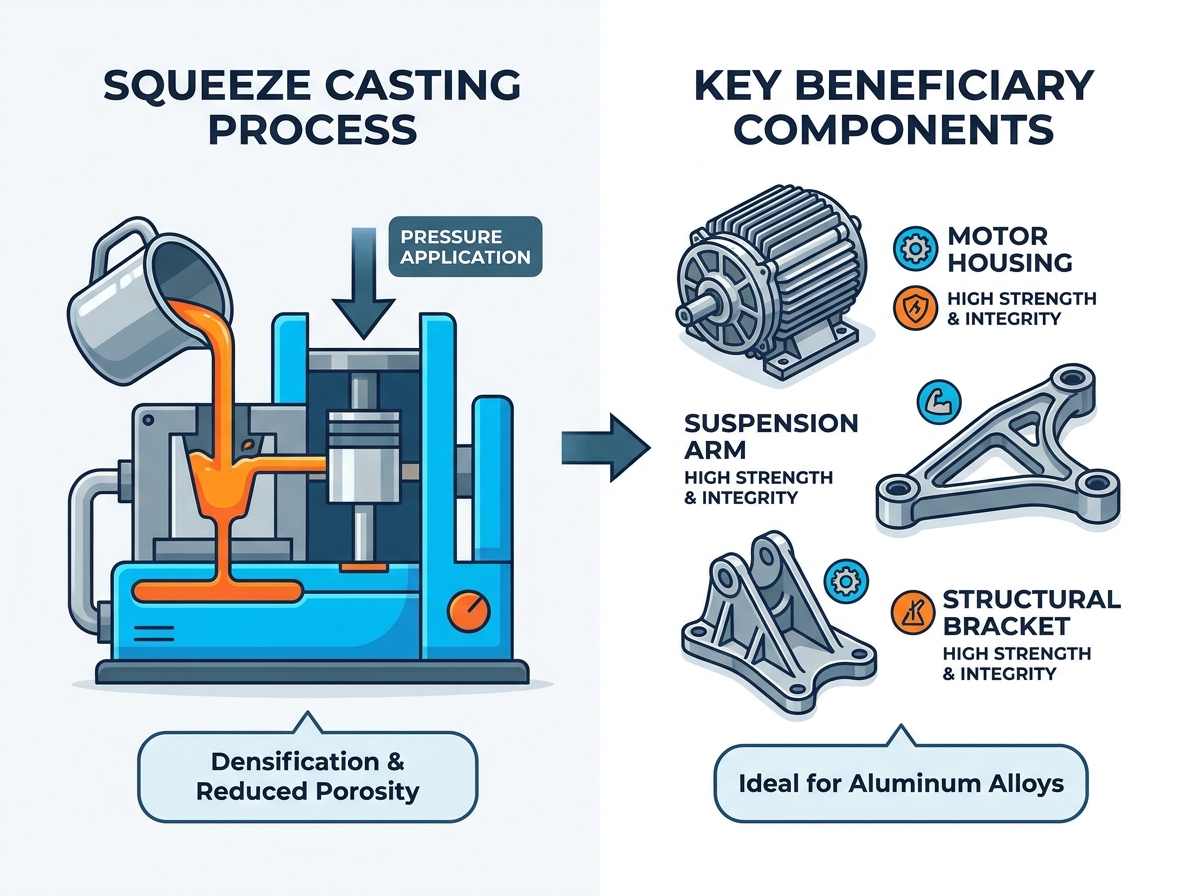
The automotive sector is undergoing a massive transformation. Original Equipment Manufacturers are scrambling to meet global fuel efficiency standards. Consequently, liquid metal forging has naturally emerged as a primary manufacturing method for safety-critical components.
Suspension components endure immense dynamic stress, continuous road vibration, and millions of high-fatigue cycles. A structural failure here is catastrophic. Historically, engineers relied on heavy steel forgings to guarantee fatigue strength. Today, advanced casting techniques provide the required mechanical strength while allowing for complex, weight-optimized geometries that traditional forging cannot easily replicate.
Structural chassis architectures are evolving rapidly. To improve handling dynamics and reduce mass, automotive engineers increasingly rely on lightweight alloy assemblies. These replace heavy cast iron or multi-piece stamped steel weldments. Engine mounts and chassis nodes require extraordinary rigidity to absorb massive impact energy during a collision. The dense, uniform dendritic grain structure provided by this process ensures highly predictable deformation characteristics.
Hydraulic braking systems operate under extreme conditions. Fluid pressures often spike above 2,000 PSI during heavy braking events. The components housing this fluid must remain absolutely pressure-tight. Even microscopic porosity in a brake caliper leads to insidious fluid weeping and ultimate brake failure. The immense pressure applied during solidification ensures a completely void-free, leak-proof internal structure.
The rapid transition to electric powertrains introduces entirely new engineering challenges. Power density and thermal dynamics are now top priorities. The housing encasing the electric traction motor must perform multiple critical functions simultaneously, making it a perfect candidate for high-pressure solidification.
Electric vehicle motors generate intense, localized heat during rapid acceleration. Efficiently dissipating this thermal energy is critical to maintaining motor efficiency and protecting rare-earth magnets. Dense, void-free metal provides vastly superior thermal conductivity compared to porous alternatives. By eliminating insulating micro-voids, the housing acts as a highly efficient heat sink, rapidly transferring thermal energy away from the motor core.
To manage extreme heat, engineers design intricate, helical water jackets directly into the aluminum motor housing casting. Liquid coolant pumps through these thin-walled channels under continuous pressure. Minor shrinkage porosity allows coolant to seep into electrical components, causing catastrophic short circuits. High-pressure solidification guarantees that the thin walls separating the water jacket from the internal motor cavity remain entirely leak-proof.
Electric motors operate at significantly higher RPMs than internal combustion engines. They generate high-frequency electromagnetic whining and vibrations. Without a loud exhaust system to mask these sounds, high-frequency noises become highly noticeable. The superior material density and structural rigidity of these housings fundamentally alter the resonant frequency. This structural stiffness naturally dampens electromagnetic vibrations, dramatically improving the vehicle's acoustic profile.
In the aerospace and defense sectors, component failure is simply not an option. Materials face the most rigorous testing and certification standards in the world. Liquid metal forging provides flawless material integrity for these extreme environments while offering substantial cost advantages over traditional billet machining.
Aerospace engineers constantly battle the buy-to-fly ratio. CNC machining structural brackets and load-bearing nodes from solid billet yields excellent strength but results in massive material waste. This advanced method allows engineers to produce complex aluminum alloy casting parts with a high strength-to-weight ratio and a near-net shape. This drastically reduces material waste while strictly maintaining the mechanical properties required for flight-critical hardware.
Defense applications demand components that withstand extreme environmental fluctuations, massive G-forces, and explosive internal pressures. Munition housings and guidance system chassis must exhibit highly predictable mechanical behavior. The process produces a fine, uniform dendritic grain structure throughout the entire cross-section. This consistent microstructure ensures reliable performance under ballistic stress.
Beyond transportation, the heavy machinery and industrial equipment industries require components that survive in harsh, highly abrasive environments. As any seasoned pump engineer will confirm, internal flaws are the absolute enemy of fluid dynamics.
Picture an industrial excavator operating in sub-zero temperatures. Its hydraulic systems manage fluid pressures exceeding 5,000 PSI. In these unforgiving environments, the integrity of a directional valve body is non-negotiable. Traditional methods frequently leave behind microscopic shrinkage voids. Under high pressure, hydraulic fluid penetrates these micro-pores, leading to external weeping. Squeeze casting guarantees a dense, pressure-tight seal throughout the entire cross-section, eliminating the need for costly secondary vacuum impregnation.
Rotational components face immense centrifugal forces and dynamic stress. If a cast impeller contains internal voids, the mass distribution becomes uneven. This leads to rotational imbalance. Over time, this imbalance causes severe vibration, premature bearing wear, and eventual catastrophic failure at high RPMs. Because these parts are formed with zero internal voids, they exhibit excellent mass uniformity and perfect rotational balance. Furthermore, the dense microstructure provides superior wear resistance against cavitation and abrasive fluids.
Choosing the correct process requires carefully balancing mechanical requirements against production costs. While liquid metal forging offers superior metallurgical properties, it is not always the most economical choice for every single component.
This advanced process is the definitive choice when mechanical integrity cannot be compromised. Engineers should specify this method for thick-walled parts where standard die casting would inevitably result in severe center-line shrinkage porosity. It is also mandatory for parts requiring aggressive T6 heat treatment to achieve maximum tensile strength.
High-Pressure Die Casting remains the most cost-effective solution for ultra-high-volume production where extreme mechanical strength is a secondary concern. If you are designing thin-walled cosmetic parts or non-load-bearing covers, the faster cycle times and lower tooling costs make it the vastly superior economical choice.
Process Characteristic | Squeeze Casting | High-Pressure Die Casting |
|---|---|---|
Metal Flow Dynamics | Slow, laminar fill prevents air entrapment | High-speed, turbulent fill traps air |
Internal Porosity | Virtually Zero | Moderate to High |
T6 Heat Treatability | Excellent | Poor |
Mechanical Strength | Very High | Moderate |
Ideal Geometry | Thick-walled, complex structural components | Thin-walled, cosmetic, or lightweight enclosures |
Transitioning a component from a traditional sand mold into a high-pressure solidification environment requires a specific engineering approach. Product designers must adapt their CAD models to align with the unique physics of the process.
The fundamental rule is to facilitate smooth metal flow. The applied hydraulic pressure must reach all areas of the casting before the metal freezes. Engineers should design parts with gradual transitions and generous radii. Because the molten metal grips the steel die cavity tightly as it cools under immense force, generous draft angles are required on all vertical surfaces to prevent galling during ejection.
The choice of alloy drastically impacts final performance. A356 is universally considered the gold standard for high-strength applications in this process. It contains approximately 7 percent silicon, providing excellent fluidity during the slow filling phase. When processed correctly, an A356-T6 part achieves exceptional yield strength and fatigue resistance. Conversely, alloys like A380 offer a highly cost-effective alternative for industrial components that require good strength without thermal processing.
While squeeze casting requires a higher initial tooling investment than basic sand pouring, the long-term return is undeniable. It delivers unparalleled value for components demanding absolute structural integrity, pressure tightness, and complex geometries. By effectively bridging the gap between design flexibility and the raw power of mechanical forging, this methodology solves some of the most demanding structural engineering challenges of the modern era.
Whether you are developing lightweight structural nodes for aerospace or engineering a leak-proof liquid cooling system for EV powertrains, liquid metal forging provides the reliability your project demands. Are you designing a component that requires the strength of a forging with the intricate complexity of a casting? Explore our comprehensive manufacturing solutions at QSY Casting. Contact our engineering team for a technical consultation today, and let us help you select the perfect alloy and process for your next high-performance project.
The primary difference lies in the fluid dynamics of the molten metal and the pressure applied during solidification. HPDC injects molten metal into a die at extremely high velocities, causing a turbulent flow that inevitably traps pockets of air. In contrast, squeeze casting pours the metal slowly to maintain a laminar flow. Once the die is closed, massive hydraulic pressure is applied and sustained throughout the entire cooling process, crushing any shrinkage voids.
Yes, absolutely. This is one of the greatest mechanical advantages of the process. Because the slow filling and high-pressure solidification eliminate trapped internal gases, the components safely undergo aggressive T6 heat treatments. Attempting to heat-treat a traditional HPDC part causes trapped air pockets to rapidly expand under high heat, blistering the surface and compromising the structure.
Generally, it is a much more cost-effective solution for complex geometries. While initial tooling costs for heavy-duty steel dies are similar to forging dies, the manufacturing process allows for the creation of intricate internal features and near-net shapes that forging simply cannot achieve. This drastically reduces the need for extensive, time-consuming secondary CNC machining.
Aluminum alloys are the most prevalent due to their excellent strength-to-weight ratios. A356 is the most common alloy specified because its silicon content offers great fluidity, and it responds exceptionally well to T6 heat treatment. A380 and A390 are also frequently used for industrial components requiring high wear resistance.
Fatigue failure typically originates from microscopic internal defects or surface porosity where stress concentrates. By applying sustained high pressure during the freezing phase, this method eliminates these micro-voids and creates a highly refined, uniform grain structure. This dense microstructure significantly delays crack initiation and propagation, leading to a fatigue life that closely mirrors forged billets.
Thanks to the immense pressure applied, the molten metal perfectly replicates the intricate details of the steel die. This allows manufacturers to achieve tight near-net shape tolerances, often within ±0.1 mm to ±0.2 mm depending on the part size and geometry. Consequently, engineers can design parts with minimal machining allowances, saving both material and secondary processing costs.


